Sunday, October 20, 2002

The Heaven of Mercury (2002)

Rod Serling must be counted as one of the most influential 20th Century talespinners; his main creation, The Twilight Zone, if considered as a 5-year-long (rather than X-pages long) short story anthology, would be a perennial backlist bestseller, ranking easily with, say, Winesburg, Ohio or The Complete Short Stories of Flannery O'ConnorBut images don't necessarily age as well as words: the production values, the fashions, the reflected culture all conspire to make those groundbreaking episodes seem quaint by modern standards. Not to mention the Zone stories and their elements have been copied, recycled, and imitated palely by scores of lesser storytellers, so it's easy to reverse attribution -- you might think you've Tasted This Before, but the truth is, this time you're drinking from the Well, not from a bottle of filtered tap. The oft-copied elements seem familiar, but the tingling Soul of those stories remains true and pure and poignant. This is the feeling I had while reading Brad Watson's new novel, The Heaven of Mercury. That I had found a Well, pure, true, and deliciously deep.

It's a puzzle every modern Southern author faces: how to cultivate something new out of the battered old landscape. Southern Lit (coming to be known as "Grit Lit" in some circles) is now practically a genre unto itself, with its own Gothic story elements and character archetypes and settings; excessive re-combinations of these pieces lead to an intrinsic sameness and predictability, which fails drama. Watson has solved this puzzle. A picture emerges of a slightly different kind of Old South. Not Faulkner's old South of dusty roads and crumbling plantation mansions; this is the pre-Segregation, middle-class South: brick downtowns, shaded suburban homes, timeless in a way, not yet taken over by television and franchise chain-stores, and so retaining an indigenous flavor and heritage. A place outwardly stolid yet troubled, like the Illinois of Ray Bradbury or the backroads Maine of Stephen King. Just as those places are vexed by lost innocence and the supernatural, Watson's Mercury, Mississippi, is plagued by broken dreams, missed opportunities, repressed racism, and unrequited love.

As described by Dante, Mercury is the second level (out of a possible ten) of Paradise, where dwell the spirits of folks who achieved great things for the wrong reasons -- despite themselves or by accident. Even though it might have been a self-serving motive, well, you done good, and here's your reward. Mercury, Mississippi is an apt Earthly counterpart, where the characters collide and influence each other through their missteps -- sometimes comical, sometimes severe -- and the achievements are personal rather than grand, but the scale inclines rather than degrades.

The first half of the book follows an incomplete arc, describing nearly in full the lives of the principals: Finus Bates (Mercury as messenger: local newspaperman and elder radio personality) and his lifelong infatuation with Birdie Wells (whom Finus once saw perform a naked cartwheel, capturing his heart in orbit forever) set the trajectory for all the according storylines. He could never quite reconcile her real presence with what her presence suggested to him, and it kept him not only enchanted but also confused in some deep sense he couldn't grasp. But early on, Finus loses Birdie to the courtship of rival suitor Earl Urquhart, and subsequently finds himself in an unhappy, besieged marriage to Birdie's friend Avis Crossweatherly. There is also maid Creasie and her commonlaw husband Frank, whom Creasie believes is a wood-spirit made flesh, and Parnell Grimes, Mercury's funeral director, fevered with uncanny drives linked inexorably to his profession: through the blessed privilege of sensual touch lay contact with the spiritual world.

The book contains some of the best set pieces this side of The House of the Seven Gables. There's a breathtakingly ghoulish turn in the chapter titled "The Dead Girl." A violent family squabble and its long-term repercussions are detailed in "Blood." "Through the Mockingbird" depicts an eerie but redemptive journey through a graveyard. Late in the book, "A Lost Paradise" describes a Fort Morgan peninsula, circa 1906, so pastoral and idyllic that it makes the current development there seem the work of the Devil himself.

Watson builds these episodes (which unfold in a slightly disconnected, overlapping sequence, an evocation of memory itself) around immediate, emotional moments -- the death of a child, the passion of a lubricious affair -- but lets the narrative transgress outwards, into the future, until the reader finds himself viewing a scene as through the reversed lens of a telescope. This approach doesn't take the steam out of the drama, but rather gives it a context, just as a spotlight, illuminating a single character onstage, becomes subsumed by surrounding stage lights as they brighten to expose greater action taking place concurrently within the shadows: the fearful illusion of mortality -- and immortality, as well -- is lifted like a veil to reveal something simpler and more profound, without fear.

There is a latent racial divide in Mercury, defined by resigned acceptance rather than sensational, expressed tension, though it does resonate throughout the novel. The African American population lives in a ravine-sheltered shantytown, and is portrayed as nearly mythic: insular, strange, and half-wild creatures of the wood, more in tune with a natural order than their white counterparts, living in the proper if long-stagnant town, could ever hope to be. Shown through the voodoo/occult practices of Aunt Vish, who dispenses arcane potions from her cabin outside of town, they are neglected touchstones to man's more instinctive side, to forgotten knowledge, finally to secret retribution. As time passes, the Mercury blacks begin to trickle out to homes in old neighborhoods ... quietly slip their best (as wood creatures slip into our midst unbeknownst) into the local public schools and the state universities beyond, to live as real human beings in the real world.

Meanwhile, Watson addresses the imbalance with a grimly humorous symbol. An "electric Negro," a wooden dummy painted with minstrel features, built for use in some store window-display now as outmoded as the machinery of slavery itself, is kept locked in a shed behind Earl's house -- a legacy claimed but shunned, at least in the immediate. "Why don't they plug you into the electric? I know what you'd do. Go kill them all. Cut they throat." Though this dummy does indeed play a role, if only as a kind of silent Greek chorus, singing chords which resonate not to the ears, but to more sublime organs of sense.

Love and loss move through Watson's characters like alternating current. Viewed through his panoramic lens, they live long enough to suffer the deaths of wives, husbands, children, and eventually each other. The usual grief that applies to such final losses are not necessarily the defining moments here. It is the pulse between those lapses that counts; it is the carrying on that delivers them: The air is adrift with what presences are left behind, which find new forms in the living, in those who are most open and alive themselves, not slaves to ignorance and fear.

So although the book seems to end half-way through, with a string of obituaries written for the newspaper owned by Finus, the second half, mimicking planetary retrograde, doubles back to fill in those gaps which, during the initial pass of the story arc, disappeared as if into the cosmic haze described in the opening moments of the novel, or as if into the haze of memory itself. And there are plenty of surprises remaining before the narrative proceeds again forward, gently as a washing tide, even offering glimpses into distorted slips of air that revealed, like thin and vertical flaws in a lens, the always nearby regions of the dead.

Central to this second half is Selena Oswald, the young woman who becomes wife to Parnell Grimes. Selena, raised by the overpowering figure of her Primitive Baptist mother, makes a choice to give herself over to the Spirit; thereafter she believes in her capacity to perform "miracles:" She could make her teacher call on her for an answer, if she wanted to ... she could change the weather ... but more often she merely willed the weather to stay as it was, since she liked most kinds of it. Watson's observation of these ways we distract and illusion and thus invent ourselves unwittingly is at the heart of his humor and charm, and also his capacity to be heartbreakingly honest -- sometimes within the space of just a few words.

As the story doubles back on itself, it creates a pristine rendering not just of unrequited love, but unrequited life, as the two central characters look back, together, on their decades in Mercury, and Finus is able to imagine a time when love was more real to them then, when there were fewer things you could use to distract yourself from a thing which was so frightening and strange. This is not patterned drama, but a convincing interconnected web of lives and choices, a long journey through a tangled wood all as if in a semiconscious dream, a pretension of life ... a free traveling current or pulse in the passage of time -- yet viewed as a sudden whole, seeming therefore timeless -- moments intact and perfect as blades of grass plucked from a summer field. All time is in a moment ... these shapes are just the forms of memory and imagination.

By extending such a grand focus and by eschewing the typical heavy-handed Gothicism that infuses Southern storytelling, Watson approaches his territory with a resonant, laid-back, ironic humor that echoes Mark Twain in his more tender moods. At one point, Finus thinks: You couldn't convince a body anymore that there was integrity in the use of language. The entirety of this book is an argument for that integrity. The novel's prose is nearly tactile -- as refreshing and welcome as a finely blended milkshake on an August afternoon, going down rich but smooth and cool. The nectar, indeed, of a freshly discovered Well. And as the words grew fewer and fewer, I found myself wishing Watson's narrative would yet again, somehow, double back on itself and renew and continue: Seemed like something that would've had to happen in a separate universe or something. Maybe it had.

Originally published in the Mobile Register as "The Ascent of the Messenger," October 20 2002

Monday, July 29, 2002

Ode to the Headless Horseman

I did request to be last in this Consanguinity Lecture Series because I knew that a horror movie at 10am would run everybody off... The idea for this programming came, oddly enough, from an essay of mine that John Sledge published on the Mobile Register's Sunday Bookpage a couple months ago, and, to follow the analepse even further, the idea for that essay was born of a conversation I had about the movie O Brother, Where Art Thou? which is supposedly based on the Odyssey. "Loosely based" is I think the operative phrase.

So that begs a question -- Loosely Based -- what should that mean in terms of converting stories in books to stories in movies, and why should it be a good thing? The idea I tried to put across in the article is that Books and Movies are two different types of storytelling, using different languages. Words in books seep into consciousness and memory, they play upon what we've experienced and felt. Movies do the same thing, but the language of icons and images, as opposed to words, is more immediate. With movies, we're given the experience. Now, I'm not saying one form of storytelling is better or more legitimate than the other. (I can be a Snobbish Reader -- I've worked among books for the past twelve years, in bookshops and in libraries. But I love movies too.) After 100+ years, movies have certainly established themselves as an artful form of storytelling. What I'm saying is that it seems to me, because I so often hear the phrase The Book Was Better, that these two essentially different forms of storytelling are being unfairly, if commonly, compared.

So there are two regions of responsibility for avoiding this. One is on the head of the Reader, and one is on the head of the Filmmaker. As Readers, we have to let go of our preconceived notions about the way our favorite stories are told on the page. By proxy, when we read stories, they become ours -- we fill in the holes left by the writer with our own images, the characters look like ourselves or our friends (or -- gasp! -- our favorite actors), the locations are our favorite places, real or imagined. The way the characters are revealed to us, through their own memories and reflections and interior monologues -- all the things that make us feel that we personally know these characters -- these things are impossible with film (unless the filmmaker resorts to a cheesy voice-over narrative, which makes everything sound like it was written by Mickey Spillane).

For their part, the Filmmakers must recognize this and move on with what's best for the Story (with a capital S), no matter what their source material, be it a book or a play or a picture, or even some form of stationary art -- anything that carries a narrative idea. I think it was Marshall McCluhan who said of TV and movies that in their pure form, you should be able to take away dialogue and sound, plug up your ears and still be able to interpret the action and follow the story, which ought to be told in an entirely visual way. But of course, we rely on dialogue and language even in movies, since that's our primary form of communication in daily life, so maybe that's where some of the confusion is so easily brought to bear. At any rate, I think Filmmakers should bear that in mind, and strive to create something new, and not have us expect exactly the same of their films, because in doing so they are doomed to fail. And we are doomed to be disappointed, if we don't allow them to create something new, and to accept the film on it's own terms.

Actually, some of the criticism that I heard and read about Harry Potter and the Sorcerer's Stone, which came out last fall, speaks to this argument. Chris Columbus tried too hard to simply mimeograph scenes from the book onto celluloid, and it came out stilted and lifeless. If he'd played with the material more, perhaps he could have avoided that. It's difficult to say. Certainly the Lord of the Rings: The Fellowship of the Ring, which was fairly faithful to the events of the book, in my opinion maintained a lot of drama and passion. I've read those books I-don't-know-how-many times, and yet I was on the edge of my seat. And although it's not a book or a movie for everybody, Terry Gilliam's Fear and Loathing in Las Vegas, based on Hunter S. Thompson's well-known book about drug use in the 1970s, managed to capture the manic, chaotic energy even while sticking close to the book. So maybe there is a level of moviemaking skill that transcends this argument, as well.

Okay, that was the gist of my original idea, and my essay for John. Though truth be told, my very original idea for such an essay goes back even farther than the O Brother Where Art Thou? conversation, to the time when this movie, Sleepy Hollow, came out.

I have loved Washington Irving's story for a long time, since I was a kid and so young that I can't tell you exactly when or how I first encountered it. I know I saw the cartoon version on Wonderful World of Disney, one evening near Halloween, but it seems that even then I was already familiar with the "Legend" in some way or other, that the parts making up the story -- the goofy underdog hero, the terrifying Night Journey, and of course the dreaded Headless Horseman -- were already a part of my understanding of the world. They are archetypes, of a sort. (Indeed, the Night Journey has become such an integral part of American Literature, from Hawthorne's Young Goodman Brown meeting the Devil in the woods at night, to Poe's Narrative of Arthur Gordon Pym, up to Oedipa Maas' venture into midnight 1960s San Francisco in Pynchon's postmodern fable The Crying of Lot 49 -- this symbolic rendition of a Dark Night of the Soul is surely so much more than a foppish schoolteacher spurring a donkey through a darkened dell, trying to outrun a hellish, headless revenant. Surely it's more than that... There's some reason we're all secretly afraid of the dark, right? There's some truth to this Legend, right?...)

Irving is considered our first successful American writer -- that is, he was the first to make a living at it. (Others wrote before him, obviously, like novelist Charles Brockden Brown.) The Legend of Sleepy Hollow is the last story, or chapter, in a book called The Sketch Book of Geoffrey Crayon, published semi-anonymously by Irving in 1819 and 1820. In the main it is a kind of diary or journeybook kept by an anonymous traveler, leaving America and revisiting the Old Country. But embedded within these earnest and true-to-life sketches and impressions are three short stories, planted like red herrings. The other two are The Specter Bridegroom and Rip Van Winkle, and all the stories are told as if they are true, just as true as the other things described throughout the book, such as the English customs of Christmas Eve. Not that I've done any real digging in the interest of research, but I wonder what some of the man-on-the-street reaction was to these tales, at the time of publication. It amuses me to think, and it's not an entirely ridiculous notion, that some folks might have been rightfully confused by this context -- much as were many people several years ago, when the movie The Blair Witch Project appeared. That movie supposes itself a documentary about some vague, spooky manifestations in the New England woods, and all the commercial hype surrounding it played the story as "true." There were "making of" specials on TV to promote the movie, and these too were done as serious documentaries. Many were fooled, including a couple of my own friends, by this angle. In this day and age, this ostensible Information Age, if it's that easy to hoax someone with a movie, surely in 1820, a lot of people took the Headless Horseman as fact... as did I, at the tender age of eight.

At that age, I was even taken in by that key word in the title: the Legend. Sleepy Hollow sounds like a real enough place to me. And a Legend, isn't that like an old story, a true story, passed down through time? At that age I was also scared easily, and I watched what I could of this affable, harmless-enough cartoon through fingers I held up in front of my face. So my comprehension of the story, filtered through fear and the resulting inability to watch, was a little iffy. (I saw it not long ago, and you can't imagine a more docile horror story -- I mean, it's narrated by Bing Crosby, after all.) So for a long time I "understood" the story of the Horseman to be describing some event, distorted perhaps but still an event which really happened...

Imagine my disappointment, then, when I finally read the story in 8th grade, still too young to appreciate all the intricacies, all the details, the careful structure, and most especially Irving's distinctly ironic, American humor that makes it, still, one of the best short stories ever written. I was only irritated to discover: Dammit! There's no actual Headless Horseman! It's just Brom Bones acting like a jackass to run Ichabod Crane out of the country, so that he can have the full attention of Katrina Van Tassel. And let's face it: none of these characters are really very likable. Brom is a sulking bully, Ichabod is a blustering coward who is most interested in marrying into the family that will feed him best, and Katrina is feckless, attaching herself to whichever man is still around at the end of the day. They need a headless horseman to come along and keep them in line.

So I was pretty happy when Tim Burton came along with his version of events, Sleepy Hollow. I don't know much about Burton personally, but I like his movies, which are typically dark, atmospheric, and contain huge doses of comic irony. His first big movie was a surreal look into the afterlife called Beetlejuice, then he directed the first two Batman movies, ten years ago; Mars Attacks makes fun of the 1950s alien invasion movies; Edward Scissorhands, also with Johnny Depp, is one of the strangest romantic comedies you'll ever see; and Ed Wood is about the man who made some of the worst low-budget movies in Hollywood history (Martin Landau won an Oscar for playing Bela Lugosi in that movie).

Sleepy Hollow takes the characters and premise of Irving's story, tosses everything into a kind of blender, along with other tropes cribbed from the Gothic Novel, popular in the early 1800s. And for my money, for as much as I've learned to appreciate Washington Irving, this version is a little closer to what the kid in me expected, those decades ago. Here you will find an actual ghastly Headless Horseman galloping across the countryside, chopping off heads of the citizenry. So it becomes a murder mystery, and a bit of a campy one, with a supernatural twist. (And it doesn't spoil any of the major plot when I tell you here that, at last, Brom Bones gets what he deserves.)

In approaching this movie, I don't doubt that Burton recognized the need to shuck the original story and concoct something new using only the essential elements. And he's done it so wildly, viewers have no choice but to accept or reject this movie on its own terms. It's a moot point to say that Irving's story is better than Burton's movie. But consider this: I think Washington Irving would have appreciated what Tim Burton did. Irving, for his day, was a pretty experimental writer, and he loved toying with the conventions of storytelling. Looking back on his canon of short stories -- and following these successful experiments showcased in the Sketch Book, Irving for a while dabbled very seriously in fiction before turning back to nonfiction, such as his biography of his namesake, George Washington -- Irving has left us many templates for the form, and it can be said that, along with writers like Guy de Maupassant, he helped to popularize short-form fiction. I think of a story called The Stout Gentleman, a first person narrative told from the POV of a man staying in a wayside inn, who knows this unnamed Stout Gentleman only by reputation and a few things he's overheard. And the whole story is this narrator, himself unnamed, imagining what this Stout Gentleman might look like, and what his business might be, and what his private life might be like... and all the while the reader is being led to the conclusion that the Stout Gentleman will eventually be revealed. Well, not to ruin it, he isn't, and the story becomes a clever joke on the reader. It's to Irving's credit and charm that the reader isn't simply aggravated by the twist ending to this tale, just as the reader doesn't moan in disgust at the end of The Legend of Sleepy Hollow, with all its fops and nitwits. You've been entertained. And at the hands of a master storyteller.

And because many of his short stories were retellings of older folktales from the oral tradition (the same strategy as Chaucer, by the way), I think Irving had a great sense of how yarns spin themselves anew, every so often. And here in Tim Burton's movie, we have a full-tilt homage to Gothic Horror, such as it was in Irving's day, in the novel form rather than the short story. The most famous of these novels are The Castle of Otranto by Walpole, and The Mysteries of Udolpho by Radcliffe, and The Monk by Matthew Lewis, which is a great, late 18th century stew of sexual decadence and political prurience and deals with the Devil, all of which ends horribly; you'd never think those folks back then could be so bad. So in this movie, the ghosts are real, and the characters believe in them to a point nearly of the grotesque, and there's some phantasmagorical... gore thrown in just to make it boil over the top.

A careful viewer will notice lots of elements from Irving's story, including several things that are only mentioned by Irving, but which Burton expounds upon, like local legends about "the great tree where the unfortunate Major Andre was taken," as there's a significant tree in the movie; and "the woman in white, that haunted the dark glen at Raven Rock" also makes an appearance. There are more obvious similarities: Ichabod Crane is still a blustery wuss, though his station in life has changed from schoolmaster to early American detective. The iconic midnight ride is acknowledged, complete with flaming jack-o-lantern, as is the covered bridge, and the churchyard which marks the border of the Horseman's power, though all in a very different light than in Irving's version.

The film is also atmospherically and texturally beautiful, and does a fair job of depicting the dark, dreamy, slightly ominous atmosphere that Irving sets up in his early paragraphs. Burton's ultimate message regards the fact that our technological advances have never really outstripped our capacity for superstition. But mainly he does a brilliant job of evoking Washington Irving's story, without actually copying it. And in that sense, it's entirely successful.

Originally presented at the Fairhope Public Library "Consanguinity" Books-to-Movies Lecture Series, July 29 2002

Sunday, June 30, 2002

Stone, Wood, Water

It is three days before Christmas and only a few degrees above freezing in Concord, MA when I crest the rise in Sleepy Hollow Cemetery known as Author's Ridge. Laid out below me is a slumping dell clustered with graves, wound through by footpaths that crisscross before leading back out through the trees. The morning light sets aglitter a few stubborn patches of snow; in contrast the slatted shadows of the evergreens seem as heavy as the tombstones over which they pass.

Family plots are numerous -- central obelisks swarmed by smaller stones, like satellites orbiting a fixed celestial point. Such are the markers for the Family Thoreau, at the head of the ridge. The focal marker is tall and stout but of modest craftsmanship, bearing only names and dates -- no titles, no epitaphs. At the northeast corner of the plot, on ground suitably gnarled with the exposed roots of a nearby oak, stands a simple weather-worn stone, barely a foot high. Henry. It is adorned by no "bawbles" but a few yellow flowers only, preserved in the cold, and by piles of smaller stones, undoubtedly brought by other pilgrims, from the Pond to here. Many a traveler came out of his way to see me

The Thoreau family marker broadcasts a long shadow across the footpath, over a plot of graves even more anonymous, each marker carved identically with a single name: Hawthorne. We sometimes congratulate ourselves at the moment of waking from a troubled dream; it may be so the moment after death. Bartlett's 1885 guide to Concord describes Nathaniel's grave as "surrounded by a low hedge of arbor vitae, as if the gifted author sought in death the modest retirement which he loved in life." No such flora exists now, and I am left to guess that Hawthorne's grave is the one farthest from the path. It too is garlanded with frozen daisies.

A walk farther down this increasingly sunlit path reveals a who's-who resting ground of 19th century Transcendentalists and social reformers and literati who were the architects of the American Renaissance -- that moment when we at last shrugged off English and Continental cultural influences and came into our own on the stage of Global Thought. A man is a bundle of relations, a knot of roots, whose flower and fruitage is the World. Here is Elizabeth Peabody, the progressive educator who opened the first kindergarten in the United States. Here is Harriet Lothrop, author of Little Peppers and How They Grew. Here is Sam Staples, the constable who jailed his friend Thoreau, thus inspiring Civil Disobedience. The Alcott family is marked by an elaborately carved obelisk, still faithfully decorated each Memorial Day by the residents of Concord.

Finally there stands a towering boulder of native pink quartz, alchemically glistening as though fresh from the quarry. Bartlett mentions that friends of Thoreau, after his passing, had intended to place just such a monument at Walden Pond; that dedication seems to have been reserved instead for his mentor and friend, Ralph Waldo Emerson. Give me insight today, and you may have antique and future worlds.

And here I pause. There is a natural expectation of graveyards for a spectral haunting, or at least some chance of revelation -- that to visit and refresh a feeling of loss and disconnection will allow us to reroute those emotions into something more privately constructive. These are the places where we might allow the Dead to lead us back to ourselves. A parapsychologist would argue that the expectation itself is the key; poltergeists appear only in conjunction with certain personality types, just as specific chemical reactions occur only when the correct elements are mixed in the correct proportions.

If so, then this particular morning the Dead and I don't mix. Nothing can bring you peace but yourself. My own experience with death has convinced me funerals and burials and the hallowed grounds that result are for the living. (What living person haunts the site of his future burial, if he knows it? What ghost would want to linger at his eternal one?) The spirits of the departed, if they move among us, are more likely to do so in familiar environments, both psychic and physical, and appear to us in ways to which we are most receptive.

So though I have come here to pay my respects to a pocket of men and women who noticeably shaped their world, and I believe still weave a certain magic in our own, I am left bereft. I am too late, even to kneel before unfamiliar stones and send silent prayers, a few words of thanks… Perhaps they have been dead too long, and there is nothing beneath these rocks but dust, and more dust. For what are they in all their high conceit, when man in the bush with God may meet?

The fabled row of black ash trees leading to the front door of the Old Manse is now gone, as is the apple orchard which once connected the backyard with the bank of the Concord River. It is certainly the most unexcitable and sluggish stream that ever loitered, imperceptibly, towards its eternity, the sea. Only a few winter-barren birches remain. Leaves float on an updraft breeze, like angels seeking heaven at last.

The Manse itself appears much as it did in 1770, when it was built according to the specifications of Rev'd William Emerson (Ralph Waldo's grandfather), and the furniture within still dates from the time of construction. Relatively modest by current standards, the arched, barn-like structure was the first two-story (three, if you count the garret) home in Concord; chock-a-block extensions of the ground floor snake from the rear, toward the river -- symbolic of Concord at-large, which has expanded and modernized gracefully, retaining a historical identity without falling victim to excessive over-development and franchising.

This persistence of Native Spirit could very well be attributed to the silent influence of the Manse. Built for a minister and later inhabited mainly by clergymen, including Ezra Ripley, it seems a spot conducive to that reverence and meditation which concerns the soul. Awful to reflect how many sermons must have been written there. One exception was Nathaniel Hawthorne -- a "profane lay occupant," though certainly known for wrestling with his own Demons of Morality; Mosses from an Old Manse was scribed here, including Young Goodman Brown's midnight encounter with the Devil. Hawthorne claimed the house haunted by none other than Ripley -- describing how door latches would raise without the aid of human strength, and cold otherworldly gusts would sweep through the rooms.

As a gift to newlyweds Nathaniel and Sophia, upon their moving in, a new garden was planted on the south side of the house by Henry Thoreau; each spring this vegetable patch is resurrected, as per the specs of Hawthorne's journals, with the eventual produce donated to local soup kitchens. The giddy Hawthornes employed Sophia's wedding ring diamond to etch inscriptions in the windowpanes of the upstairs study (the room where Emerson wrote "Nature," a cornerstone of the Transcendentalist movement, a few years prior). These etchings can still be seen: Nath Hawthorne/This is his study/1843.

Through this same window, eighty-six years earlier, William Emerson viewed a singular skirmish on the planks of the Old North Bridge. Here once the embattled farmers stood. Four hundred minutemen, tipped off by Samuel Prescott, lay in wait for the advancing British army. (Paul Revere was already captured at Lexington, ten miles east of Concord.) Setting a pattern which has resonated throughout history, the Americans did not fire until fired upon, but at the command of Major John Buttrick -- Fire, fellow soldiers, for God's sake, fire! -- let loose volley after volley after volley, and sent the Redcoats scrambling.

The original bridge, of oak and stone, was dismantled in 1793 due to dilapidation from wear, weather, and war. When Hawthorne wrote the introduction to his Mosses, only a modest cenotaph erected in 1825 marked the spot. (Some locals were rankled that this monument stood on the east bank, where British, not Colonial soldiers, fell.) The North Bridge now in place, built in 1956 and of a design and materials meant to replicate the original, links with the west side where stands the famous Minuteman statue, commissioned by Louisa May Alcott's friend, Daniel Chester French.

If there is any ounce of soil that might be said to lay claim to the conception of the American nation, this is it. Yet this field, separated from the Manse grounds by a shin-high stone fence, interested Hawthorne less as a historic battleground than as a former Indian village. Thoreau, who has a strange faculty of finding what the Indians have left behind them, first set me on the search. It is not hard to imagine the two of them, Thoreau stooping low to scrape the earth with the blade of his garden-trowel, while Hawthorne allows himself a moment of distraction at the beauty of the early springtime blue squill in bloom. There is an exquisite delight in picking up an arrow-head that was dropt centuries ago, and has never been handled since, and which we thus receive directly from the hand of the red hunter.

The first places we go in seeking a past, whether personal or cultural, are the graveyards. The stones point the way back into immovable history, even as the temporal sun winds shadows around and around them. Time is but the stream I go a-fishing in. I drink at it, but I see the sandy bottom and detect how shallow it is. We are, for the same reason, drawn to the wood in well-traveled homes -- window sills and doorframes, shelves, cabinets, the handles of hammers and shovels, knives and cutting boards -- any place that wears away beneath our hands, soaks up our natural oils, allowing the grain to rise and speak in testimony of our arrivals and departures, of the work we have done.

In the Concord woods, one half-mile from Walden Pond, is a ten-by-fifteen foot patch of land, lined in stone. A small house once stood here. I went to the woods because I wished to live deliberately. A replica of that house stands nearer the pond; it is built of new and treated wood and will serve, for now, as well as any monument.

And here is a kettle-hole, formed 12,000 years ago by the retreat of a mighty glacier. It is lined with evergreens, along steep grades that lead down to a broad sandy cusp. The water is mirror-clear: green and silver where it reflects the trees and sky, shading to blue towards the center, where mysteries arise about its ultimate depth, a quarter-mile from shore. The scenery of Walden is on a humble scale, and does not approach to grandeur.

On the shore, a curiosity on this bitter winter day, a lone seabird pecks at the shallows. My life is like a stroll upon the beach, as near the ocean's edge as I can go. The temptation is too great not to walk toward it, as though it might carry some message... but the bird launches itself from the sand, over the water, then into the sky.

Overhead, the moon floats in the afternoon heavens -- that glowing rock loved by poets and dreamers ever since we have had language for our dreams. For it is those dreams that allow us to trespass against time -- and language that allows us to navigate the way. In a way, it is Language that brought you here... Heaven is under our feet.

Closer, to the spot so hurriedly abandoned by the seabird, where just beneath the water caressing the shoreline is a smooth white rounded stone, about the size of an egg and appearing to hold as many secrets, and as much promise. The water is cold, remembering the glacier it once was. The stone is quickly fished from the shallows, snatched from the threshold of another world. Not a stolen treasure, but a measure of wordless insurance -- proof that this place is real.

What better could be done for anybody, who came within our magic circle, than to throw the spell of a tranquil spirit over him? And when it had wrought its full effect, then we dismissed him, with but misty reminiscences, as if he had been dreaming of us.

Originally published in the Mobile Register, June 30 2002

Sunday, March 24, 2002

Pentimento: Paper Projections

Before I saw the movie myself, I took in several reviews of Billy Bob Thornton's take on Cormac McCarthy's All the Pretty Horses, most of which echoed a lazy sentiment: The Book Was Better. I've been a reader since before kindergarten, worked among books for more than a decade now, and this phrase increasingly annoys, belying as it does a blanket disregard for storytelling in a medium other than that of the printed page. If the filmmaker made a bad movie, okay. But saying "the book was better" is a reaction particular to one's appreciation of a book, not a review of a film. In that regard, what I would really want to know is whether or not the film does justice to that source material -- the Story Itself -- and not the novel by which one came to first know that Story.

I believe there exists, like a diamond floating somewhere on the ethereal plane, an Essential Idea for a story, of which a book, channeled through one particular writer, is only a single facet. It should be that Essential Idea which is followed -- a smart filmmaker should reach beyond a novel and into that idea -- fully aware he's using a different medium (nobody would expect a painting or a radio show or a stage version to be the same as a book -- why do we expect it of film?).

Writers like John Barth or Kurt Vonnegut, whose works present particular difficulties for the Silver Screen, might be the first to argue that a story is, first and foremost, in the telling. It was an argument good enough for Twain, after all. But moviemaking is a specific and very different way of telling a story than is writing. The currency of language is images, not words. Think for a moment about great movies which were conceived as movies -- and how poorly they might fare as novels. Citizen Kane. O Brother, Where Art Thou?. Even Night of the Living Dead draws a great deal of its effect from what is seen (and also by what is not seen) and heard; a textual version would lose a fair amount of impact -- unless of course major changes are implemented.

A few movies do manage to change or even transcend their source material. Jaws. Love Story. Forrest Gump. Think what you like about their content -- the makers of these movies openly accepted the books as mere source material, and by not attempting mere visual translations of what was already on the page, but warping the situations to befit the celluloid medium, perhaps they produced something that improved upon the textual basis, and perhaps revealed more of the Source. Why should we think a book is automatically the best way to tell a story, simply because it appeared to us first?

There's terminology in the painting arts to describe evidence of change to the original composition: pentimento. Often the opaque pigment with which the artist covered a mistake or an unwanted beginning will, with time or injudicious cleaning, become transparent, and a revelation of original intentions will become visible through the finished composition. A celebrated example is Caravaggio's Lute Player (in the Metropolitan Museum of Art) in which X-ray photography was used to uncover evidence of the painter's original intention. 

Tim Burton's Sleepy Hollow, for example, uses Washington Irving's famous tale as a transit point for a loving exposition and homage to Gothic storytelling traditions. Irving's legendary headless specter was an excuse for a bit of fun between rival suitors, a 19th century version of The Blair Witch Project; in Burton's version, the Horseman is a visceral revenant, summoned forth by a witch for purposes of greed and revenge. In execution, the stories are nearly mirror-opposites, but both respect a central idea -- the way we weave tales in our lives ultimately gives shape to those lives.

On the other hand, the filmmakers of The Name of the Rose didn't pretend they could bring to the screen all of Umberto Eco's philosophical and religious musings, the intricate symbolic structure, the deep political machinations of the Inquisition. At best, within a 2-hour celluloid environ, these things could only be mentioned or evoked, rather than expounded and invoked. Indeed, the opening credits name their attempt a "palimpsest" of Eco's novel -- terminology for a partially erased and written-over manuscript. But boiling the 500-page novel down to its murder-mystery core was a moot exercise -- all the meaning of the book lay in the clues, not the solution -- and the filmmakers offered nothing new or different as an offset.

Billy Bob Thornton faced the same sort of puzzles by taking on Cormac McCarthy. Celluloid cannot possibly convey the moment young John Grady Cole looks out across the plain and envisions the exodus of the Indians: "…nation and ghost of nation passing in a soft chorale across that mineral waste to darkness bearing lost to all history and all remembrance like a grail the sum of their secular and transitory and violent lives." It is, in total, a passage less than a thousand words -- but an equal number of pictures (about 41 seconds, at 24 frames per second) could never match their worth.

A moment later Cole picks up, Hamlet-style, a horse skull he finds in the sand, and turns it, and listens to the sand shifting inside it. And while that alone is certainly a filmable event, the narration that precedes and follows it, which lifts the scene aloft in meaning and character, evokes things which cannot be seen, or filmed. Film, therefore, must necessarily try something else.

Thornton, for his part, tried to reach beyond McCarty's prose; he spent a lot of time capturing the sweep of the Mexican vistas, but ultimately finally fell victim to the same trap as did, say, Demi Moore's version of The Scarlet Letter (for which, I am sure, Nathaniel Hawthorne is still a-spin). In these books, much of the action takes place by way of character monologues, or observances and impressions -- Thornton follows McCarthy's book too closely with his camera, and when the characters finally open their mouths to explain themselves, the results are staged, stilted speeches. The only way around this would have been to change the story itself to fit the visual medium (well, I'll give Moore's Letter an A for effort in that regard -- I sure don't remember any sponge-baths in Hawthorne's novel).

These are also matters of perception and expectation, in our visual age. We have to acknowledge that movies can't be books, nor should they want to be. Still, a rare success, when truly successful, fuels that expectation -- and so we sit through a thousand more bad film adaptations, hoping to be treated again. The film that comes to mind is To Kill a Mockingbird, which I recently (and correctly, in my opinion) heard described as a "perfect distillation" of the novel, to the point that "we think we're remembering the book, when we're really remembering the movie."

I can think of only one other book that could be paid such a compliment -- Dracula. The nuances of Stoker's elongated Victorian melodrama are now all but forgotten as we recall simply the icongraphic mugging and hypnotic gaze of Bela Lugosi, who drills down to the very sinister heart of the character and takes viewers through the story in just 70 minutes. Lugosi was chosen for the film (after Lon Chaney turned down the role) thanks to the strength of his performance in the stage production. Which brings us back, finally, to what someone else once said, about being true to the Muse, about the Play being the Thing…

Originally published in the Mobile Register as "Double Images: On Paper, On Screen," March 24 2002

See Also:
Ode to the Headless Horseman
The Scales of Myth

Sunday, December 23, 2001

Gravity's Rainbow (1973)

In mid-August, I started rereading Thomas Pynchon's Gravity's Rainbow, which I'd last read around the time the Cold War was thawing. Following the 1997 publication of Mason & Dixon, an extravagant, decadent, hilarious re-imagining of American history, I'd revisited his other novels, but despite my admiration for it I neglected his Big Book, telling myself it was too long, too troublesome -- really just too much work. I'm unsure now what changed my mind here of late, maybe just the notion that good books change through time as will good paintings under shifting afternoon light, and that the time had come for me to read it again.

The plot of Gravity's Rainbow, such as it is, winds around a conspiratorial quest for an experimental V2 rocket, code-numbered the 00000. In the aftermath of the Second World War, a menagerie of characters from all races and nations grope across war-torn Europe: some seek the rocket (or, later, at least information about it), some seek each other, some seek only to disrupt the quest itself. There are plots, counterplots, red herrings, and monumental distractions. Central but by no means crucial to this labyrinthine treasure hunt is American lieutenant Tyrone Slothrop, who discovers a creepy, Pavlovian connection, dating from his own infancy, to a certain plastic used in the rocket.

Having said all that, it isn't as important to Pynchon what these characters do so much as how and why they do it -- he sometimes lingers for pages over the inner thoughts of an obsessed character. And for the first third of the novel, their obsession is the progress of the war, specifically Hitler's blitz of London as the V2 rockets come soaring in from Holland. Pynchon manages not the personal, paranoid mania of Catch-22, but a diffused, electric, collective terror. There are some moments of Heller-esque angst, but the characters mainly try to take it in stride, making oddly clinical observations as Death follows Poisson distributions across maps of the city. This is in eerie contrast to careful descriptions of the urban destruction caused by the rockets:
The rubble waits him, sloping up to broken rear walls in a clogging, an openwork of laths pointlessly chevroning -- flooring, furniture, glass, chunks of plaster, long tatters of wallpaper, split and shattered joists: some woman's long gathered nest, taken back to separate straws, flung again to this wind and this darkness.
It seems almost funny now, that I'd been thinking how Pynchon's great book had, in some ways, become an anachronism. The 750-page buildup, meticulous and beautiful in depicting the origins of the post-war world, flashes forward in the novel's closing moments to a chilling, definitive moment of Cold War fear: air raid sirens blare over Los Angeles, and The Bomb is dropped.

Entirely feasible, even viewed as inevitable by many when the book was published in the still-dawning 1970s. The subconscious anticipation of a singular Armageddon, for our world to come to a fiery, nuclear end in less time than it takes for the Red Sox to play the Yankees on any given sun-bleached Saturday afternoon, was for nearly fifty years part of everyday life. Then for a while, the blissful 1990s, it seemed such fears were newly unfounded, even quaint: there would be no Duck-and-Cover moments, there would be no Terror from the Sky.

But now, though the equations differ from our present reality, the sum of Pynchon's novel is the same: we are, in our own way, back to the Blitz. And so, for a while, I had to stop reading. The descriptions of devastation and fear were too uncannily similar -- even down to a character remarking on wartime city destruction that begins in the south and spreads north -- to what I was already seeing on television and in magazines.

But when I did resume reading, I began gleaning something different. Though caution must be observed in willful interpretation (near the end of the novel is a fictitious hymn containing the lines "Till the Light that hath brought the Towers low/Find the last poor Pret'rite one…" which is, for my money, far more prophetic than any of the Nostradamus claptrap that's been making the rounds lately) I was seeing a great deal more hope in the story than I'd previously noticed.

The very final seconds of Gravity's Rainbow take place in a London movie house. True to the clichéd motto of Stiff Upper Lip, London proceeded about its usual business during the horrors of 1944 -- up to and including all the usual entertainments. The theaters were kept open, and everyone went, brazenly so. What better way for ordinary people to withstand the barrage of rockets than to Keep Calm and Carry On, to conduct their lives as if Death were not ever above and around them, gathering its powers for a silent (or not so silent), sudden strike. Because, given pause for thought, isn't that the case every day? Don't these horrific events, be they in 1944 or 2001, merely eradicate the schedules and symbols we use to distract ourselves from that Inevitable Zero?

In Pynchon's theater, the film breaks -- a precursor to what will happen to all the lives within when a V2 rocket, falling, falling, hits the roof. But in the meantime, the patrons, who seem to know what's happening, have erupted, together -- together -- into song (actually, that hymn mentioned earlier). It is a moment that perfectly symbolizes a struggling Humanity, determined to survive, even if only because survival is all humanity knows. Yes, we will all move beyond the Zero. In due time, or undue time; perhaps naturally, perhaps violently. But for now -- for the very reason that we are Here and Now -- that alone should give us reason for Hope. That it should be our pleasures, our "distracting" schedules and symbols, be they mindless or not, that give us joy and purpose in every second of our lives.

Originally published in the Mobile Register as "What Comes Down Must Go Up: Re-Reading Gravity's Rainbow After 09/11/01," December 23 2001

Sunday, May 13, 2001

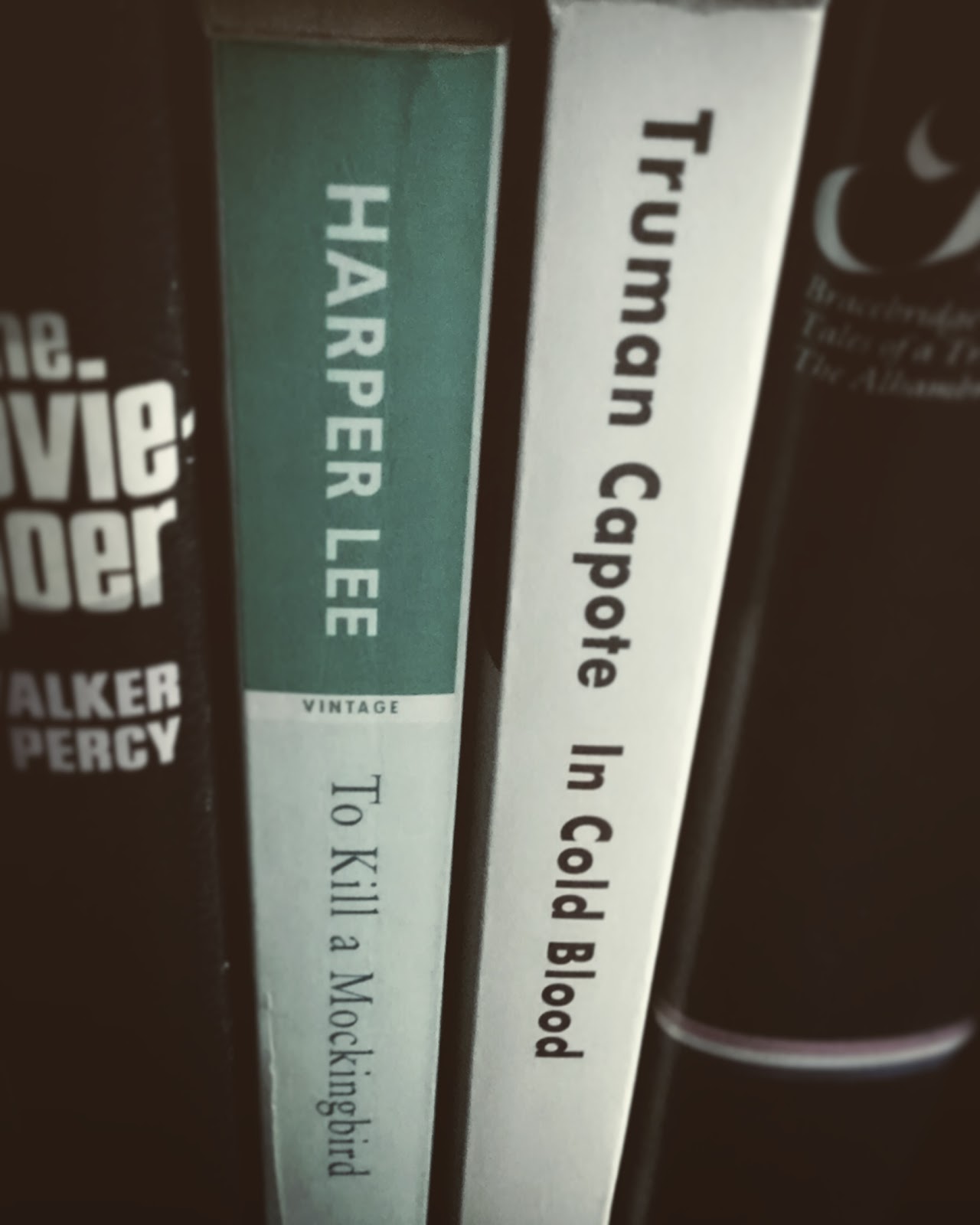
To Kill a Mockingbird (1960) / In Cold Blood (1966)

I recently spent a couple hours perusing Author Unknown by Don Foster, Vassar College professor of English and forensic linguist. Foster created an academic stir by attributing "A Funeral Elegy" to William Shakespeare; in less highbrow feats, he deduced Joe Klein as the "Anonymous" author of Primary Colors, and was also hired by the FBI to profile the Unabomber (before the Unabomber became known to us as Ted Kaczynski) based on language and idiosyncrasies in the typescript of the infamous Manifesto. As a matter of personal taste these pursuits interested me less than did a chapter on Thomas Pynchon, rumored author of a spate of quirky letters-to-the-editor sent to an alternative northern California newspaper in the 1980s, when he was supposedly in the area penning Vineland. (Foster decided Pynchon was not the guy, much to the relief, apparently, of Pynchon.)

Reading Foster's literary-gumshoe exploits brought back to mind an old regional argument: Did She or Didn't She? For years I've heard the rumor that Harper Lee did not write To Kill a Mockingbird, that it was in fact penned by her childhood buddy Truman Capote. You're likely to first hear this rumor mongered in the affirmative, something like this: It's a ridiculous notion that an unknown writer would turn out a single, perfect novel, then cease writing (or at any rate cease publishing), disappear completely from the Literary Radar, and communicate to the reading world via a profound silence that they damn well better not expect anything else from her, either. She's being silent because she's keeping a secret, and the secret is that she doesn't write at all...

Just as, in this region, you must cheer for either Auburn or Alabama, you must also take an absolute side on this issue. Reclusive as she is, "Nelle" doesn't offer much support; at least with the likes of, say, Salinger and Kesey, who made occasional appearances (even if only in the form of salacious biography), there was always hope they were still writing. Not so much with Lee, who endeavors to stay out of the spotlight. Still, the fastest way to the other side is: Hey, if you'd written To Kill a Mockingbird, you might retire from writing, too. I know I'd seriously consider it.

And while I am certainly no "forensic linguist" (I am often surprised to find, once per month when my bank statement arrives, that I myself hand-wrote a number of questionable checks) I like to think that I am a fairly alert reader -- my near-spotless driving record attests to the fact that very few stop-signs escape my notice. So I decided to read To Kill a Mockingbird and a work by Capote back-to-back, and thereby make up my own mind.

It had been two decades since I read Harper Lee's novel as a high school assignment, so I was essentially approaching it with a fresh view. I found a story efficiently told, a narrative that does little more than serve the action and the characterizations. Nothing distracts the reader from what happens on the page: no poetic diversions, no artsy intrusions, no verbal pyrotechnics. Just minimal language which perfectly suits the structure -- a powerful tale is allowed to tell itself.

To follow up, I chose In Cold Blood, which was entirely new to me. Given this story's basis in hard fact, I figured Capote would treat the material in a straightforward manner, as free of literary structure, voice, and artifice as he could manufacture. I figured this correctly: Capote did his best. But even in matter-of-factly covering the Clutter murders, he's still Capote: those charming turns of phrase, those imaginative, evocatively precise similes still spice his prose and delicately render characters and events.

I'm no expert on Truman Capote; I've read Breakfast at Tiffany's and A Christmas Memory (both of which broke my heart), I've had a go at Answered Prayers, and for what it's worth I've seen the movie Murder by Death a couple times. Nor am I an authority on Harper Lee, and I know absolutely nothing about the friendship that the two enjoyed. I only know just enough to have nearly formed my own opinion in answer to Did She Or Didn't She? even before I read these two books. And reading them merely cemented that opinion.

The whole thing, to my ear, sounds too close to the assertion that the 1969 moon landings were faked in a Nevada television studio, begging the question: Why? Any possible answers must be constructed from fringe reasoning. You certainly can't take anything away from Capote, saying he didn't write it; he's got plenty of masterpieces under his belt. And I'd rather give credit where credit is due. I firmly believe, in my amateur "forensic linguist" view (and also in my heart, where it matters most anyway) that Harper Lee wrote To Kill a Mockingbird -- just like it says on the cover. Even if you want to insist that she didn't write it -- that at some stage in the game a different hand tinkered with or restructured or rewrote the initial drafts -- I think you'd still have to admit it was written by someone other than Capote. The styles simply differ too much, according to my reading.

Still, one cannot deny the fun of playing parlor games with these ideas. It's fun to speculate how Capote may have helped Lee in places, telling her how a character should say this rather than that, how a scene might play better if written from a different perspective, that sort of thing. And it's equally fun to turn the tables on that game. If Capote and Lee were tight enough for him to edit and shape her drafts, well, how might she have affected his work? Perhaps… hmmm--perhaps it was she who devised A Christmas Memory, that fundamentally sentimental tale that is nearly singular among Capote's writings. Maybe Harper Lee even wrote it, from idea to draft to finish, and Capote only did a final polish. Hmmmm….

I'm sure she'll never tell.

Originally published in the Mobile Register, May 13 2001 as "Cold, Cold Mockingbird"

Tuesday, December 12, 2000

M.R. James & the Horrors of Christmas

It may seem incongruous at first to be discussing ghost stories at Christmastide. A little reflection, however, will render it perfectly natural. After all, 'tis the season of the most Holy Ghost story of all. But even excepting that, literary tradition provides exceptional groundwork for such a discussion -- beginning with not just one of the most famous ghost stories ever written in English, but perhaps the most famous, most copied, most adapted piece of fiction (short or long) in any language: Charles Dickens's A Christmas Carol (1843). The three principal ghosts of that tale are part of our Literary Subconscious, and though at least two of them differ from the traditional specter -- the modern day versions of which have roots in the Gothic Tradition of the late 1700s -- they do represent, for good or ill, what we all hope for at this time of year--to receive a blessing, a message, a revelation from the Great Beyond.

Actually, few 19th century readers saw an incongruity with ghost stories during the Advent season. Magazines were a flourishing medium and many featured, in their popular Christmas issues, tales of spooks and goblins. Though some of these followed a maudlin sub-genre of "heartwarming" horror stories (pale imitations of Dickens at best), many were more typical of the Gothic stylings of Elizabeth Gaskell or Henry James's The Turn of the Screw -- a tale told "on Christmas Eve in an old house." And it was tradition on the campus of King's College for a small group to gather in the Provost's chambers to hear M.R. James premiere his latest ghost story...

Montague Rhodes James was born on August 1, 1862 in Goodnestone parsonage, Kent, where his father was the curate. He died 74 years later, in 1936. He was a precocious child, developing an early taste for reading and for old books -- he would rather examine dusty library volumes than play with children his own age. The story may be apocryphal, but it's certainly interesting: at the age of 6, James became ill with bronchitis and while recovering, bedridden, he wished to see a 17th century Dutch Bible that he had previously perused in the library of a friend of his father's, Bishop Ryle. When the book was sent, James reportedly sat up in bed for the first time in days so that he could examine it more closely.

When in better health, young Montague Rhodes spent time wandering the low, flat landscape of County Suffolk, playing in the fields beneath pressing cloud-cover and visiting in the huddled villages, certainly an apt environment for one inclined to think in ghostly terms. In fact, such inspiration did take place early on, as he related to the Evening Standard in 1931: "What first interested me in ghosts? This I can tell you quite definitely. In my childhood I chanced to see a toy Punch and Judy set, with figures cut out in cardboard. One of these was The Ghost. It was a tall figure habited in white with an unnaturally long and narrow head, also surrounded with white, and a dismal visage. Upon this my conceptions of a ghost were based, and for years it permeated my dreams."

James didn't plan his interests in life around any sort of writing other than that which would concern research. After mastering the classics and several languages first at Temple Grove School, then at Eton College, he graduated to King's College, Cambridge, where he was quickly elected a Fellow. He spent some time as an assistant in classical archaeology at the Fitzwilliam Museum. Following his dissertation, titled The Apocalypse of St. Peter, James began lecturing in divinity, and eventually became dean of the college in 1889. He was a Bibliophile in an age when that term carried a professional connotation -- these days he would probably be called a "Library Scientist" -- that particular guy lurking in the dusty back room of the university library, tending the special collection, the rare and fragile volumes which students are rarely, if ever, allowed to touch.

He was a distinguished medievalist, specializing in illuminated manuscripts and apocryphal Biblical literature. His training and skills as a linguist and biblical scholar, along with an uncommonly keen, near photographic memory, enabled him to write copious reviews, translations, full-fledged works on bibliography, paleography, and other antiquarian studies. In addition to editing numerous volumes for specialized bibliographical and historical societies, James endeavored nearly forty years to catalog the many manuscript collections in Cambridge. And his translation of the Apocryphal New Testament in 1924, widely heralded at the time, is in print to this day. In 1905 James was installed as provost of King's College; later he served as vice-chancellor of the university from 1913 to 1915. In 1918, James left the halls of King's to accept the post of Provost of Eton College where he continued to study and catalog medieval manuscripts. He was awarded the Order of Merit in 1930, remaining active until his death in 1936.

For someone so busy, so intensely researching the past, James exhibited none of the expected gloomy traits of the scholarly recluse. Biographers paint him as an extrovert, very social, and though he never married (the archetypal confirmed bachelor, perhaps), he maintained a number of quality friendships. His research often required him to travel abroad, which he did enthusiastically -- these journeys formed the backgrounds to several of his tales. (His impressions of Sweden, for example, provide the atmosphere and setting for his story "Count Magnus," and the title character is based on a real historical figure, a 17th century count which James uncovered during his research.)

Yet for someone so dedicated to his work and so respected in his time as a scholar of antiquaries, M.R. James is chiefly remembered -- even best represented -- to us by off-hand stories written during his leisure hours. Indeed, most scholars of the field consider James to be not only the best of the Victorian period ghost-story-tellers, but to have essentially invented the modern horror story. His stylings and structures show their influences in the work of H.P. Lovecraft, Shirley Jackson, and Joyce Carol Oates, and resonate all the way into latter-day X-Files and Blair Witch investigations. ("Casting the Runes," published 1911, was the inspiration for Jacques Tourneur's 1958 film Curse of the Demon.)

The stories which James read during Christmases a century past have never left print. Following their oral premieres, many of the tales were first published in the Cambridge Review and like magazines. These were later collected in the volumes Ghost Stories of an Antiquary (1904), More Ghost Stories (1911), A Thin Ghost and Others (1919), and A Warning to the Curious (1925). He also wrote a short supernatural fantasy novel for children, The Five Jars (1922). In 1931 the first edition of the Collected Stories appeared, which included a brief but informative preface, and an afterword entitled "Stories I Have Tried To Write" -- a handful of uncollected stories written for special occasions (such as "Wailing Well", written in 1927 for a campfire reading for the Eaton College Boy Scouts) were also included. [Depending on how the fragments are counted, James wrote between 35 to 40 ghost stories -- slightly more than the 31 to 33 which are usually anthologized into "complete" editions.]

During his days at King's, James fell in with a gathering known as the Chitchat Club. In October of 1893 he was asked to write a ghost story for the purpose of reading before one of the group's gatherings, slated for the week before Christmas. By the sole illumination provided by firelight and a few flickering candles, James read two stories: "Lost Hearts" and "Canon Alberic's Scrapbook." He was apparently a terrific orator, adept at mimicking voices and providing Dickensian accents for the minor characters; the club was so taken that he was invited to make a tradition of his story-telling each year at Christmas.

Many writers of the time (following Poe's example, presumably) worked out formulas for the creation of their stories, and James was no different. He cites three general guidelines in the introduction to Ghost Stories of an Antiquary, the First being: "The Setting should be fairly familiar and the majority of the characters, and their talk, should be such as you may meet or hear any day…" As with all these rules, James practiced what he preached. His stories were inspired by and derived from his interests and surroundings -- and are thereby filled with exactly the kind of droll, meticulous detail and scholarly asides that you might expect of a tweed-elbowed professor prattling on about a research project which, by the way, uncorked a rather nasty chain of events… and this does give them a definite ring of authenticity.

Suitably, the plots most often revolve around a single character who, in a quest on behalf of a college or museum for a curious or rare artifact, stumbles across something extraordinary. This allows James to pepper his tales with his own knowledge of archaic matters. Ghost stories are often considered as atmospheric pieces, but James was more an artist of incident and arrangement, and of verisimilitude -- appealing first to intellect and reason, then to emotions. Without foreclosing supernatural events, the stories begin with his subjects going about their business in their usual ways… and then things begin to go slowly awry.

Secondly, according to James, "the ghost should be malevolent or odious…" Even better, he never completely reveals his creatures -- he's happier with a few horrible suggestions, thereafter leaving the rest up to the reader's imagination. His few specific evocations serve only to make his ghosts "inconsistent with the rules of folklore." Actually, few of his creatures resemble what we typically think of as a floating sheet-like specter; these expectations are a holdover from Gothic tales, where ghosts were more often than not linked to the principal characters via a bloodline, either overt or forgotten. James's spirits behave more like an invoked curse: they are cause-and-effect manifestations, everyone is vulnerable, and their behavior predicates in many ways modern-day poltergeist theories. As such, though they may be described with restraint, these beings are anything but polite. He seems to have a predilection for swarthy, dwarfish, hairy creatures. Several stories also feature, in James's own term, "dreadful spiders." Traditional Gothic ghosts were first seen, or heard, at some safe distance; an M.R. James ghost would more likely brush up against you before you knew it was in the room.

His third element concerned the "technical terms of 'occultism'; if they are not very carefully handled, [these] tend to put the mere ghost story upon a quasi-scientific plane…" James was actually careful not to extend any explanation to the events in his stories, be they current or ancient. His ghosts and goblins, thanks to his meticulous detail, do appear to be obeying some Hidden Law, which is best interpreted simply: There Are Certain Things Left Alone. At some point, reasonably intelligent and alert persons should become aware that the time has come to obey this Law -- the title of one of James's more famous stories embodies this creed quite well: "A Warning to the Curious."

James once said, in putting forth an explanation of the fantastic, "It is sometimes necessary to keep a loophole for a natural explanation, but I might add that this hole should be small enough to be unusable." This is his MO in the story "Number Thirteen," in which a cousin of the narrator, traveling in Denmark in order to research Roman Catholicism in the country, takes a room at an inn which has a disappearing and reappearing room numbered 13. This room exists only at night, and is apparent only in the shadows thrown from its window -- strange dancing figures projected onto the wall of the building across the street. At the climax of the story, an attempt is made to forcibly enter the room, but dawn breaks and the door vanishes under the blows of the crowbars. All this would seem utterly without explanation were it not for some documents uncovered by the main character in the course of his (seemingly unrelated) research, which recount the story of a man accused of witchcraft and treachery to the church, and mention is made of land he may or may not have owned in some undisclosed sector of the city. The reader is thereafter left to make any connections he sees fit.

His perhaps most famous story, and by far the simplest in terms of structure, is "Oh, Whistle, and I'll Come To You, My Lad." The tale evokes a sense of Kismet -- no matter what the motive under which a person commits an action may be, he will receive apt consequences in return. A certain Professor Parkins takes a holiday during which, in the act of doing a little scouting around for an anthropologist friend, finds himself caught in a series of bizarre events involving vague distant figures and howling winds, the epicenter of which seems to be a silver whistle he finds in a decrepit burial ground. A fellow vacationer translates a cryptic inscription on the whistle as "Who is this who is coming?" Professor Parkins, unfortunately, feels compelled to blow the whistle and find out. In the events that follow, James uses a common, spectral figure, but escapes stereotyping in its very boldness: "Now it began to move, in a stooping posture… it must be blind, for it seemed to feel about it with its muffled arms in a groping and random fashion… Parkins described… a horrible, an intensely horrible, face of crumpled linen. What expression he read upon it he could not, or would not, tell…" The floating, immaterial bedsheet-ghost is of course a crude and timeworn image, but James manages to transcend it, making it both obvious and uncanny, as the supernatural force possessing (as it were) the bedsheet is not the moaning, chain-clanking spook of Gothic romance, but rather a malevolent creature bent on strangling Professor Parkins...

As to whether or not M.R. James himself believed in ghosts, the question is vexed. Some scholars maintained that he definitely did not believe; James on the other hand appears to at least have been open-minded: "I am prepared to consider evidence and accept it if it satisfies me." Still, there is no evidence that such an acceptance was ever made, and James apparently exhibited no interest in the contemporary activities of the Society for Psychical Research. (His last tale, "A Vignette," is perhaps an attempt to capture in fiction a childhood experience which James may have believed to be truly supernatural.) I think James may well have agreed with Samuel Johnson's observation on the subject of ghosts: "All argument is against it, but all belief is for it."

On that note: Merry Christmas.

Originally presented at the Fairhope Public Library Tuesday Book Review and Lecture Series, December 12 2000

Sunday, October 29, 2000

Haunted in Salem

We got lost, wending our way into Salem. The highways surrounding Boston (which were well marked... weren't they?) sent us spiraling deeper, deeper into the New England landscape. Gazing at the frost-encrusted granite and the shuddering white birches along the roadsides, it was no stretch to imagine that we were intersecting, late by more than a century and at inconsiderate speed, some well-trodden path favored by Henry David Thoreau in a search for berries, or Nathaniel Hawthorne on one of his solitary, melancholy constitutionals.

Weaving through Danvers (where the infamous witch trials actually took place, where slave Tituba spun supernatural tales for impressionable young girls), then Peabody, we at last landed in downtown Salem. The historical center is still a drowsy village huddled at the water's edge -- at least, as drowsy as the tourist trappings allow. My first view of the city was a narrow, cobbled street, lined on either side with shop windows displaying all manner of "witch" merchandise. It was as if the gift kiosk outside the Haunted Mansion at Disney World had spawned an entire town, or Anne Rice had spellbound and redecorated the French Quarter in her own image.

Perhaps due to familiar association, I was not immediately struck by the plethora of shore-side commercialism. Those of us who've seen decades pass on the Gulf Coast treasure our memories of unspoiled dunes as wave upon wave of developers now strike the beaches and ever-cresting condominium roofs pile toward the horizon. In that spirit, several Bostonians chided my excitement to see the town: "Walden? Salem? Those are tourist traps now, too commercial…" Still, I was like a person coming to the shoreline for the first time, having been landlocked for months in some cold climate, to be dazzled, despite the condos, by the glistening white sands, by the thump and rush of the waves, by the sunlight melting through the salt-flecked atmosphere. By those natural forces which exist -- and will continue to exist -- despite what man erects to exploit them.

Salem, maybe, has something humanely tangible to "exploit." There is a perpetual Halloween atmosphere, and the holiday itself is celebrated with as much intensity and verve as is Mardi Gras on Southern shores -- museums, shops, restaurants, even private homes are transformed into graveyards, haunted houses, spooky dungeons. But these surface clichés belie an undercurrent of seriousness -- selling Witch City fridge magnets is the least they can do. Here, the supernatural is sincerely indulged; as if in penance for all the wrongs committed in the name of the Unseen, there is now not mere tolerance but actual liberty. The Witch Trials Memorial, a stone's throw from the central burying ground, was dedicated in 1992 by Holocaust historian Elie Wiesel. In a candleshop I overheard the word coven spoken without stigma, being used synonymously with congregation. Salem is home to Laurie Cabot, officially appointed in 1988 as State Witch. And farther towards the old seaport, the souvenir shops remain but take on a more underground flavor, and the windows become a little darker, a little more suggestive. There's a definite sense that all this isn't being done merely to attract tourists… though that's certainly the acceptable impression.

But I wouldn't be haunted, at least not by witches. Due to time constraints, I was unable to visit Concord, Thoreau's stomping grounds. (Though I did at least learn the correct pronunciation -- rhymes with conquered -- and anyone saying, as I always had, "CON-cord" would be looked upon with as much disdain as would a Yankee in these parts mouthing a word such as "MO-beel" when everyone knows it's properly pronounced "moe-BEEEEEL.") I was thus intent on getting an eyeful of the House of the Seven Gables.

At the dead end of Turner Street, the Pyncheon home (actually the Turner-Ingersoll Mansion) still overlooks the gull-infested north end of Salem Harbor. It is now part of a settlement association, and the grounds contain a collection of five other trucked-in structures, including Hawthorne's birthplace (which resembles a mini-Old Manse); all of these are on the National Register of Historic Places, thereby qualifying the site as its own historic district. The famed House of Seven Gables, built in 1668, is itself one of the oldest surviving 17th century wooden houses in New England. Painted a dark, dark gray, it is actually of humble size, though composed of odd, near-occult angles.

I visited at low tide on a cloudy day, seabirds invisible among the lower cumulus, their disembodied cries drifting eerily through the air. Hawthorne, the Alcotts, Ralph Waldo Emerson, all of whom knew this place, would doubtless have seen identical days, from identical standpoints. And here was I, in this age of cellphones and internet (not to mention the jet that had helped bring me to this spot), marveling at the "coincidence" -- though I have stood innumerable mornings on the concrete pier of my own small home town, and heard the same sorts of birds, smelled the same sort of brackish, salt-tuned air.

It is interesting how the mind seeks, even strains for, such associations -- definite, archetypal points in time, constructed of our environments -- for the purpose of deeper, familiar connection, either to ourselves or to those who have passed before us. Such is the purpose of the Civil War re-enactor, charging a rise which, at least for an afternoon, he believes to be Cemetery Ridge; or the pilgrim daring the desert sands, bent towards Mecca; or for that matter the Roman Catholic and Eastern Orthodox ritual of Transubstantiation -- these are our best efforts, our willful, faithful reconstructions of the Past into a new life, and a new memory.

I'd experienced the same heaviness of history the day before, in Boston, in the Old South Meeting House on Washington Street -- where Benjamin Franklin had been baptized, where George Washington had made one of the first speeches ("How dare they speak of the sanctity of their churches while they desecrate our own?") of the Revolutionary War -- as I listened to the plank flooring creak beneath my feet. And in the Granary Burying Ground on Tremont Street, walking past the resting places of Samuel Adams, John Hancock, Paul Revere. Slate gravestones from the 17th century rose from freshly fallen 21st century snow, bearing astonishing carvings of winged skulls and morose angels that were like visions delivered from the depths of Time.

A man and woman just up the path were remarking on the designs -- they seemed too weird and scary to her, too gothic, almost disrespectful by today's standards. I thought then of a retired old man I had once known who kept a geode shop in a converted garage, polishing and cutting into stones to reveal delicate layers of crystals, cragged ice-like geometric patterns, tiny secret caves lined with glistening rainbow-flecked minerals. Walking into his shop, folks never ceased to oooh and aaah at the contents of his display cases. "Whatever rock they pick," he would say, "always tells you something important about that person." He never explained this nugget of psychic-geomancy, but I always took it as that -- people would choose, knowingly or not, a stone that somehow revealed their inner composition, that spelled out the mysteries behind the human geology of their own faces, the crags time would eventually reveal.

There are moments of such recognition, when our souls ring, as a bell struck. I stared and stared at the House of Seven Gables, waiting for such a moment. I walked around it and counted the windows. I rested my hand on the front door-knocker. Eventually there did come a lonesome tolling -- from the church near the central burying ground, where we had parked our car. Merely a reminder that it was time to return to Boston.

Walking back, we followed the waterline, and I stopped to examine the reproduction of a pirate ship docked at the long, turfed protrusion of Derby Wharf. No doubt a souvenir boutique, I mused, allowing myself, after being surrounded by so much history yet not quite touched by it, a flash of cynicism. Which was the moment one of my traveling companions said, in the laconic manner of one simply marking the time: "Oh, there's the Customs House."

We'd already walked past it. It was as if it had chosen this instant to materialize, out of the past, just over my shoulder. Brick and granite and topped by a shining brass eagle, yet nearly unassuming -- essentially unchanged in the more than 150 years since Hawthorne described it lovingly, if bitterly, in the opening sketch of The Scarlet Letter. And as clearly as any cloud above or wave below, there, I swear, I could verily see the man, standing on the marble steps, one hand on the brass rail, coat tail fluttering in the ocean breeze -- seeing him as surely as others, long before me, had seen him of a morning, pausing for a pre-work chat, or to scan the sky for traces of impending rain. Yet, oddly, this figure, which I can still so clearly envision with my mind's eye, is nowhere in the photograph I snapped, not even a shadow…

As if the steely blue-eyed literati, Salem's favorite son, has forsaken my Kodak Moment, silver nitrate and all, just as he had eventually forsaken Salem itself: "My native town will loom upon me through the haze of memory, a mist brooding over and around it; it ceases to be a reality of my life. I am a citizen of somewhere els
e."

Originally published in the Mobile Register, October 29 2000

Sunday, March 26, 2000

The Club Dumas (1993)

There is a slim genre of literature that brings a unique joy to certain readers: the Nonexistent Book. A renowned example would be the Necronomicon, a "banned" and thus "scarce" centuries-old volume of occult knowledge (in the tradition of many great nonexistent books) which was wholly made up by pulp writer H.P. Lovecraft in the 1920s in order to lend verisimilitude to his tales of otherworldly beings who could be summoned by recitation of various passages. Belief in the Necronomicon's existence (and there are legions who will argue it vehemently) continues to this day, fostered in no small part by obscure houses who have published "excerpts" in paperback.

The labyrinthine plot of Arturo Perez-Reverte's novel The Club Dumas (translated to film with minimal effect by Roman Polanski as The Ninth Gate) revolves around just such a grimoire. Book detective Lucas Corso is hired to authenticate a manuscript fragment of The Three Musketeers, which has slipped into the possession of a dealer friend following the suicide (or perhaps murder) of its previous owner. Despite an edgy, streetwise, roguish exterior, Corso is not the kind of book scout seen at library sales or Goodwill racks; his clients are maniacally wealthy, his goods are pedigreed, and the transactions he enables are the sort documented only in behind-the-curtains auction house whispers, and which never make the papers.

Though the pacing is slowed during passages where Corso's "true" heart is examined (requisite brooding over a Lost Love; a haunting fascination with the strategic blunder of an ancestor on a Napoleonic battlefield), these excesses are quickly excused as his increasingly dangerous investigations into the validity of the Dumas fragment become intertwined with a seemingly unrelated quest: comparison of three existing copies of a famously rare demonic text: The Delomelanicon, or The Book of the Nine Doors of the Kingdom of Shadows. The books each contain nine woodcut plates, but with cryptic variations; it is Corso's job to discover the nature of these variations, which are supposedly a key for summoning the granddaddy of evil, Satan himself.

The plot proceeds as a wild conundrum of literary associations: sinister characters appear, as if summoned from the pages of Dumas's masterpiece, as Corso proceeds to decipher differences among the existing copies of The Nine Doors. Popping up like a deus ex machina is a beautiful young girl named after a Conan Doyle heroine who pauses just long enough from reading the classics to rescue Corso from several perilous encounters. There are also entertaining diversions into the world of truly rare book collecting, including a terrific set piece involving the impish Ceniza Brothers, who work to restore, repair, and sometimes forge valuable volumes. Meanwhile, Corso finds himself investigating an ever-deepening series of puzzle-like coincidences linking the occult-obsessed author Dumas with the ultimate mystery of The Nine Doors

Perez-Reverte isn't so much concerned with solving any mystery as he is with the structure of the puzzle itself, in this case how texts and characters and storylines, even seemingly simple ones, are interpreted and bestowed with independent vitality by readers. When Corso is finally initiated into the Club Dumas, the detective-novel machinations evaporate to reveal a larger force of operation: There are characters in literature who have a life of their own, familiar to millions of people who haven't even read the books in which they appear. This notion of literature existing outside the boundaries of the printed page and within the minds and lives of readers -- thus being capable of effecting events in our Real World -- is realized fully as the novel moves toward an unexpected and unsettling set of closing moments.

I won't be terribly surprised if at some future point, engaged in a search for some obscure book, I stumble across a catalog listing for a "facsimile reprint" of the 1666 Torchia edition of The Nine Doors. Perhaps, out of a perverse curiosity, I'll buy it. Or perhaps (more likely) I'll leave it for the next hungry scout, someone who just might believe he's buying the Real Thing. Readers who love fiction -- the characters, the plots, the romance and the intrigue -- inevitably carry that passion with them into the physical world. And there's a high end to the scale of that passion, Perez-Reverte is saying, and some people get the Devil they deserve.

Originally published in the Mobile Register as "Rare Volume: the Lure of Apocrypha," March 26 2000

__________________________________________
There is only one serious matter to be considered in life, and that is death.
Mankind will not be perfect until it can create and destroy like God. It can already destroy: that's half the battle.
     -- Alexandre Dumas, The Count of Monte Cristo